Inside the Clubhouse: Amenities That Matter in a Boutique Project
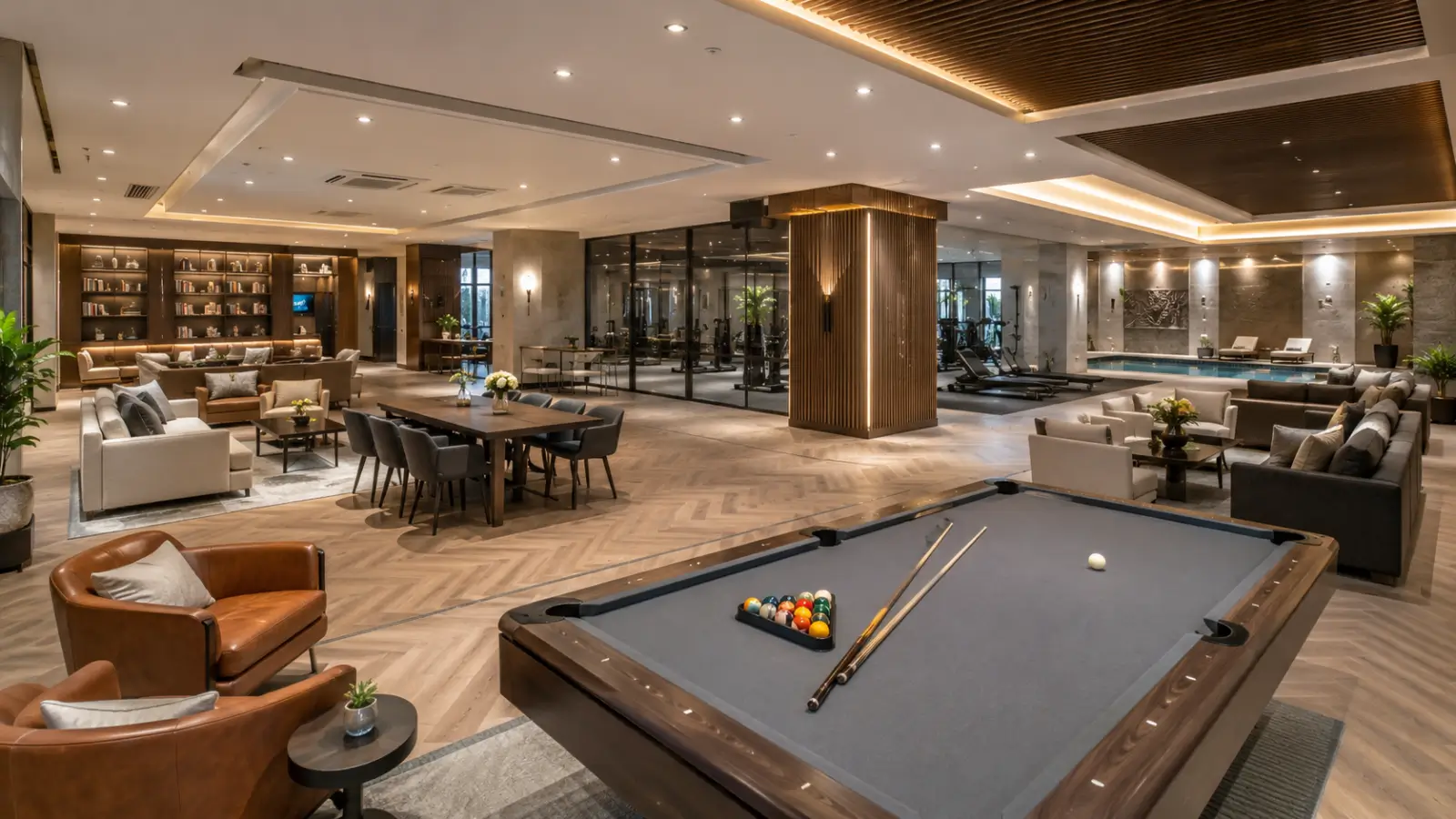
Amenity counts have inflated across every corridor, which makes them poor decision tools. Clubhouse amenities in boutique apartments are better...
Amenity counts have inflated across every corridor, which makes them poor decision tools. Clubhouse amenities in boutique apartments are better judged by two questions: how far they sit from your front door, and how many households share them.
Proximity Turns a Facility Into a Habit
Distance decides usage more than quality does. A gym two lifts away gets used on a weekday evening; one across an estate gets used in January. Boutique projects place the clubhouse at the base of the same building, which removes the walk that ends most good intentions. When assessing any amenity list, measure it in metres from the lift lobby rather than counting entries.
The Facilities That Actually Get Used
Households converge on a short list. A gym, pool and party hall in luxury flats account for most of the usage in almost every project, followed by a children's play area and a walking track. Indoor games rooms and courts serve smaller groups intensely. Everything else tends to be occasional. Check that the short list is well executed before being impressed by the length of the full one. Clubhouse amenities in boutique apartments usually concentrate on exactly those items.
The Ratio Nobody Prints
Facilities are shared, and the sharing ratio changes the experience. Serving roughly a hundred families, a pool behaves very differently on a Saturday afternoon from one serving a thousand, and the same holds for a party hall during festival season. Boutique projects trade breadth for that ratio: fewer facilities, far less competition for them. Ask how many homes the clubhouse serves before deciding which model suits you.
What Upkeep Costs
Amenities are funded by the households using them. Clubhouse maintenance comes from the monthly charge and the corpus collected at handover, and the burden tracks the size of the common area rather than the number of residents alone. A compact clubhouse maintained by a small association is usually easier to fund and quicker to repair, since decisions pass through fewer people. Larger amenity estates spread the cost but also multiply what must be maintained.
Questions for the Association
What does the monthly maintenance charge cover?
How is the clubhouse booked for private events, and at what charge?
Who operates the gym and pool, and how often is equipment serviced?
What are the operating hours, and are guests permitted?
How was the corpus set, and has a special levy ever been raised?
Safety and Supervision
Shared facilities carry shared risks. Pools need supervised hours or clear rules, gyms need serviced equipment and a first-aid provision, and play areas need surfacing that tolerates falls. Ask how access is controlled, whether guests are permitted and how incidents are handled, since these arrangements sit with the association after handover rather than with the developer. Families with young children should treat this as a primary question rather than a footnote.
Signs of Good Management
Visit an older project by the same developer and look at its clubhouse on an ordinary day. Clean equipment in working order, a pool with clear water and staffed hours, a hall that has been maintained rather than merely used, and a landscape that looks tended all indicate an association and facility team doing their jobs. Those signals predict your own experience better than a new project's renderings.
Matching the Model to Your Life
Households using two or three facilities weekly are usually better served by clubhouse amenities in boutique apartments, where proximity and low competition make them part of a routine. Those wanting multiple sports, several pools and a wide social programme may prefer a township. Neither is superior; they simply suit different weeks.
Ask for the full amenity schedule — Enquire Now
Related reading: Is a Single-Tower Project Better Than a Large Township?.
FAQs
How should I judge an amenity list?
By distance from the lift lobby and by how many households share each facility, rather than by the number of entries on the list.Which facilities actually get used?
A gym, pool and party hall account for most usage in almost every project, followed by a children's play area and a walking track.Who pays for clubhouse upkeep?
Residents, through the monthly maintenance charge and the corpus collected at handover. The burden tracks the size of the common area being maintained.
Related Articles
Global Capability Centres and Their Impact on Bangalore Housing
Captive centres changed the profile of the city's office demand, and housing followed. The gcc impact on bangalore real estate is easiest to see in...

KIADB Aerospace Park and the North Bangalore Industrial Corridor
Industrial employment shapes housing demand differently from office employment, and northern Bengaluru now carries both. The kiadb aerospace park...

What's Driving Bangalore's Real Estate Growth in 2026?
City-level narratives explain less than corridor-level numbers, which is why any answer to what is driving bangalore real estate growth in 2026...
Bangalore's Startup Scene and Premium Housing Demand
Wealth created by young companies eventually buys property, and Bengaluru has produced more of it than any other Indian city. The startup growth...